There was a time when the biggest threat to an independent artist's music was someone uploading a pirated copy on YouTube. Those days feel almost innocent now. In 2026, the threat has evolved into something far more sophisticated: artificial intelligence that can clone your voice, replicate your style, and generate songs that sound disturbingly close to your original work, all within seconds.
If you are an independent artist in India releasing music through any distribution platform, this is not a distant future problem. This is happening right now, and understanding how to protect yourself is no longer optional.
What exactly is happening with AI music?
AI music generators like Suno and Udio have fundamentally changed how music can be created. These tools allow anyone to type a text prompt and receive a fully produced song in seconds, complete with vocals, instruments, and mixing. The technology is impressive. The legal and ethical implications are terrifying for independent creators.
The Recording Industry Association of America (RIAA) filed landmark copyright infringement lawsuits against both Suno and Udio in June 2024. The core allegation was straightforward: both companies trained their AI models on millions of copyrighted songs without permission. Suno admitted to duplicating "tens of millions" of publicly available songs, and evidence showed that both platforms could generate outputs with "striking resemblances" to copyrighted recordings.
By late 2025, the major labels started settling. Warner Music Group reached licensing deals with both Suno and Udio, and Universal Music settled with Udio. These settlements mean that in 2026, both platforms are transitioning to licensed models where participating artists can opt in to allow their work to be used for AI training in exchange for credit and payment.
But here is the critical problem for independent artists: these settlements were negotiated by and for major labels. If you are an independent artist in India releasing Bhojpuri folk songs, Punjabi pop, or Hindi indie music, nobody was at the table representing you. Your music may have already been scraped and used to train these AI models, and you have no settlement money coming your way.
Why independent artists are disproportionately affected
The lawsuits filed by independent musicians in late 2025 and early 2026 make a point that the wider industry has largely ignored. Independent artists often lack the legal resources, industry connections, and organisational backing to fight AI companies on their own.
Country music artist Anthony Justice, who filed separate lawsuits against both Suno and Udio on behalf of independent musicians, argued that the major label settlements do not adequately protect musicians who are not signed to those labels. His lawsuits assert that Suno's training data consisted primarily of songs owned by independent artists, precisely because indie music is the most accessible and least legally defended.
For Indian independent artists, the risk is even higher. Regional language music in Hindi, Punjabi, Bhojpuri, Tamil, Telugu, and Bengali is widely available on YouTube and other platforms, making it easy to scrape for AI training datasets. If you have music on Spotify, YouTube, or JioSaavn, there is a realistic chance that an AI company has already used it.
What you can do to protect yourself right now
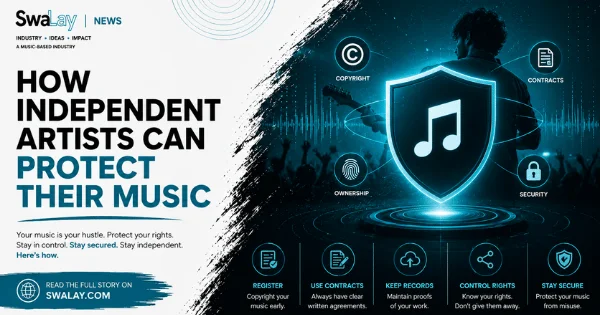
The good news is that protection is possible. It requires a combination of legal, technical, and strategic steps, but none of them is particularly expensive or complicated for an independent artist.
Register your copyrights formally
Copyright exists automatically from the moment you create a work, but formal registration with the Copyright Office of India gives you a significant legal advantage. A registered copyright serves as prima facie evidence of ownership in any court, and it is the first thing any lawyer will ask for if you need to file an infringement claim.
The process is entirely online through copyright.gov.in. Fees are ₹500 for literary works (lyrics) and ₹2,000 for sound recordings. You fill out Form XIV, upload your work, pay the fee, and receive a Diary Number. After a 30-day waiting period for objections, your registration is processed.
Get timestamped proof of creation
Beyond formal copyright registration, having an independently verifiable timestamp of when you created your work is invaluable. This is where technologies like blockchain-anchored certificates become relevant. A timestamped proof of creation, verified through cryptographic hashing and anchored to a public blockchain, creates an immutable record that you created a specific piece of music at a specific time.
This evidence is particularly powerful against AI-generated copies because it establishes that your original work existed before the AI-generated version. Without this proof, disputes become a he-said-she-said argument that is expensive and time-consuming to resolve.
Use audio fingerprinting services
Services like ACRCloud and AudD can scan the internet for copies of your music, including AI-generated versions that closely resemble your original recordings. These tools create a digital fingerprint of your audio and continuously monitor streaming platforms, social media, and other online sources for matches.
If an AI-generated song that sounds suspiciously similar to your original work appears on Spotify or YouTube, audio fingerprinting can detect it and provide evidence for a takedown request. Several music distribution platforms, including SwaLay Digital, use these tools as part of their content verification process.
Activate Content ID and Rights Manager
YouTube Content ID and Meta Rights Manager are automated systems that scan uploaded content against a database of registered works. If your music is registered in these systems (typically through your distributor), any unauthorised use of your content on YouTube, Facebook, or Instagram can be automatically detected and either blocked or monetised.
Not all content qualifies for Content ID, since public domain compositions like traditional bhajans and hymns are ineligible. But if your music is original with original lyrics, composition, and production, your distributor should be able to register it for Content ID protection.
Monitor AI-generated music platforms directly
Check platforms like Suno, Udio, and their competitors periodically for content that sounds similar to your work. If you find AI-generated tracks that appear to have been trained on or derived from your music, document the evidence immediately. Take screenshots, download the audio, and note the URLs and timestamps.
This documentation becomes critical evidence if you need to file a takedown request or pursue legal action later.
What the law says in India
India's Copyright Act, 1957, protects original musical and literary works for the lifetime of the author plus 60 years. Section 63 of the Act makes copyright infringement a criminal offence punishable by imprisonment of six months to three years and fines of ₹50,000 to ₹2,00,000.
The Information Technology Act, 2000, adds another layer of protection. Section 43 provides for civil liability up to ₹1 crore for unauthorised access to computer systems and data, which could apply to AI companies that scrape your music from platforms without authorisation.
India does not yet have specific legislation addressing AI-generated content and its copyright implications, but the existing legal framework provides a foundation for protection. The key is having proper documentation of your original work: formal copyright registration, timestamped proof of creation, and audio fingerprint records.
The bigger picture for 2026 and beyond
The music industry is at a crossroads. Major labels are signing licensing deals with AI companies, turning a threat into a revenue stream. Independent artists, meanwhile, are left to navigate this landscape on their own.
The artists who will be best positioned in this new reality are those who take proactive steps now: register their copyrights, timestamp their creations, activate platform protections, and monitor for unauthorised use of their work. The cost of protection is minimal. The cost of doing nothing could be the entire value of your musical catalogue.
At SwaLay Digital, we verify every piece of content through a 3-step process using ACRCloud, AudD, and manual review before distribution. We believe that protecting independent artists from both human and AI-driven infringement is not just good business. It is a responsibility that every distribution platform should take seriously.
SwaLay Digital is a provider member of the Indian Music Industry (IMI), affiliated with IFPI. ISO/IEC 27001:2022 Certified.