
For decades, India's global music identity was closely associated with Bollywood. But the latest numbers from Spotify suggest that something much bigger is happening beneath the surface.
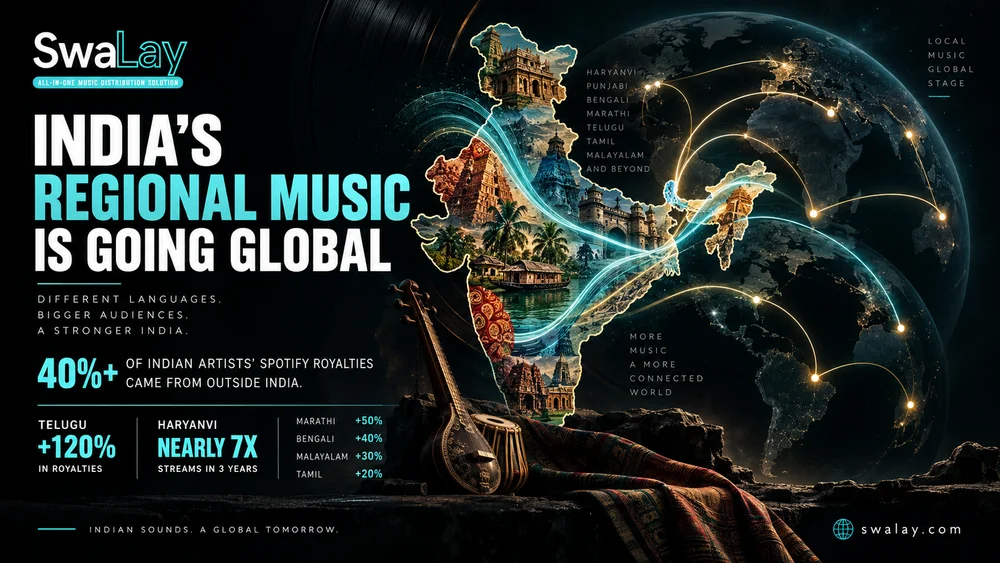
According to Spotify's newly released Loud & Clear India report, Indian artists generated 29% more royalties in 2025 than the previous year, while more than 40% of the royalties generated by Indian artists came from listeners outside India. That means international audiences are no longer simply discovering Indian music occasionally. They are becoming a significant part of its economy.
The most unexpected part is where much of this growth is coming from.
Royalties from Telugu music increased by more than 120%, Marathi grew by nearly 50%, Bengali by almost 40%, Malayalam by more than 30%, and Tamil by 20%. Haryanvi music has been even more striking, with streams increasing almost sevenfold between February 2023 and February 2026.
This changes the traditional idea of what an artist needs to become successful.
You no longer necessarily need to switch languages, move to Mumbai, or wait for a Bollywood opportunity to reach a national or international audience.
A song can begin within a regional community and travel outward through playlists, recommendations, short form content and fan discovery.
Spotify reported that listeners discovered Indian artists they had never heard before 12.8 billion times in 2025. Even more revealing, 11 of the 15 most exported Indian songs on its 2025 Global Impact List came directly from artists rather than film soundtracks.
For independent artists, this is a powerful lesson.
Your language may not be your limitation. It could be your competitive advantage.
A distinctive regional sound can create a stronger identity in an increasingly crowded global music market. What begins as a local audience can become an international fanbase when the right distribution and discovery infrastructure exists.
India's music revolution may therefore not be about making regional music more mainstream.
It may be about making the world more regional.
And for thousands of independent Indian artists, that could be the biggest opportunity yet.