
If you are an independent musician in India, you have probably heard of IPRS, PPL, and ISRA. You might have a vague sense that they collect money on your behalf. You might even be a member of one of them. But if you are like most independent artists we work with at SwaLay Digital, you probably do not know exactly what each one does, how they are different, or whether you are actually collecting all the royalties you are entitled to.
This confusion is not your fault. India's music rights ecosystem is genuinely complicated, and the information available online is often outdated, incomplete, or written in legalese that does not help a working musician trying to get paid. So let us break it down in plain language.
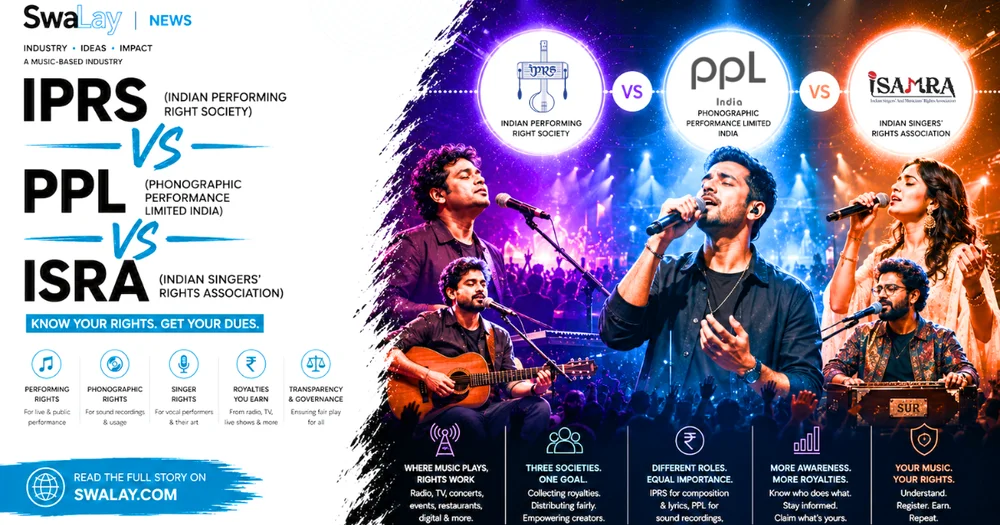
The fundamental concept: two types of royalties from every stream
Before we get into the three organisations, you need to understand one critical concept. Every time someone streams your song on Spotify, JioSaavn, YouTube Music, or any other platform, two completely separate royalties are generated.
The first is the master (recording) royalty. This is payment for the use of your specific sound recording, the actual audio file you produced in the studio. This royalty goes to whoever owns the sound recording. For independent artists, that is usually you or your label. You receive this through your music distributor.
The second is the publishing (composition) royalty. This is payment for the use of the underlying musical composition and lyrics. This royalty goes to the songwriter and composer. You receive this through a performing rights organisation.
These are two different payments, from two different systems, going to two different destinations. If you are only collecting through your distributor, you are getting only the first one and missing the second entirely.
IPRS: Indian Performing Right Society
IPRS is the most important organisation for songwriters and composers in India. It is also the one that most independent artists ignore or are unaware of.
IPRS is a copyright society registered under Section 33 of the Copyright Act, 1957. It is a member of CISAC (Confédération Internationale des Sociétés d'Auteurs et Compositeurs), the global umbrella organisation for performing rights societies. IPRS is also affiliated with IFPI through its parent body, the Indian Music Industry (IMI).
IPRS collects performing rights royalties on behalf of songwriters, lyricists, and composers. These royalties come from every public performance, broadcast, or digital streaming of your musical composition and lyrics. When a radio station plays your song, when a restaurant plays it over their speakers, when a hotel lobby streams a playlist containing your track, or when someone streams it on Spotify, IPRS collects a royalty for the use of your composition.
In FY 2024-25, IPRS collected approximately ₹700 crore in total royalties. This is money that was distributed among IPRS members based on their work usage data.
Who should join IPRS? If you wrote the lyrics or composed the melody of any song that is being streamed, broadcast, or performed publicly anywhere, you should be an IPRS member. This includes singer-songwriters, lyricists, composers, and music producers who contributed to the composition.
Who does IPRS NOT pay? IPRS does not pay the owner of the sound recording (master). It does not pay session musicians or backup singers who did not contribute to the composition. It does not pay the label or distributor.
How to join: Visit iprs.org and apply for membership. You need to submit proof of your published works and pay a nominal membership fee. Once registered, IPRS tracks the usage of your compositions through data received from streaming platforms, broadcasters, and venue operators, and distributes your share of the collected royalties.
PPL: Phonographic Performance Limited
PPL operates in a completely different domain from IPRS. While IPRS deals with performing rights (composition), PPL deals with the public performance and broadcast of sound recordings (the actual audio file).
PPL is the licensing body for sound recording owners in India. It collects royalties when your sound recording is played in public: in shops, malls, restaurants, hotels, gyms, airlines, radio stations, and other commercial establishments.
This is different from streaming royalties that your distributor collects. Your distributor collects from the streaming platform (Spotify, JioSaavn) for the on-demand digital use of your recording. PPL collects from physical and broadcast venues that play recorded music publicly.
If a restaurant in Mumbai plays your song through a speaker system, PPL collects a license fee from that restaurant and distributes a portion to you as the sound recording owner. If a radio station broadcasts your track, PPL collects for that use.
Who should join PPL? If you own the sound recording (the master) of any music that is being played in public venues, broadcast on radio or television, or used in any commercial setting, you should be a PPL member. This includes independent artists who own their masters, labels, and producers who hold sound recording rights.
Who does PPL NOT pay? PPL does not pay songwriters or composers for the underlying composition. It does not pay performers who do not own the sound recording.
How to join: Visit pplindia.org and register as a member. You need to submit proof of ownership of your sound recordings.
ISRA: Indian Singers' Rights Association
ISRA is the newest and least understood of the three organisations. It was established to collect royalties specifically for performing artists, meaning the singers and musicians who perform on a recording.
Under Sections 38A and 38B of the Copyright Act (added by the 2012 amendment), performing artists have a right to receive royalties when their performances are used commercially, independent of who owns the sound recording. This means that even if a label owns the master, the singer who performed on that recording has a separate right to receive a royalty for commercial use of their performance.
ISRA collects these performer royalties from commercial establishments, broadcasters, and other entities that use recorded music publicly. The minimum license fee for ISRA is approximately ₹3,650 per annum from commercial establishments.
Who should join ISRA? If you are a singer or instrumentalist who has performed on any commercially released recording, regardless of whether you own the master or not. Even backup singers and session musicians who performed on a track have performer rights under the 2012 amendment.
Who does ISRA NOT pay? ISRA does not pay songwriters, composers, or sound recording owners for their respective rights. Those are covered by IPRS and PPL, respectively.
How to join: Visit isracopyright.com and register as a performing artist.
The overlap and the confusion
Here is where it gets confusing. A single independent artist who writes, composes, sings, and self-produces their music is entitled to royalties from ALL THREE organisations:
From IPRS, for the composition and lyrics (performing rights). From PPL, for the sound recording being played publicly (phonographic performance). From ISRA, for their vocal performance on the recording (performer rights).
Plus, the streaming royalties from your distributor for on-demand digital streams.
That is four separate streams of income from the same song. Most independent artists are collecting only one, the distributor's payment. Some are collecting two, adding IPRS. Very few are collecting all four.
How much money are we actually talking about?
IPRS is the largest of the three in terms of collections, at approximately ₹700 crore in FY 2024-25. Distribution to individual members depends on the usage of their works, meaning more streams and performances of your compositions means a larger share.
PPL's collections are smaller because they primarily collect from physical venues and broadcasters rather than streaming platforms. The license fees from commercial establishments range from ₹5,000 to ₹10,000 per annum for metro cities, with higher fees for larger venues and events.
ISRA's collections are the smallest of the three, as the organisation is still relatively young and building its licensing coverage.
For an independent artist whose music gets moderate streaming numbers and occasional play in commercial venues, the combined additional income from IPRS, PPL, and ISRA membership might be anywhere from a few thousand to several lakh rupees per year, on top of the distributor royalties they are already receiving.
The exact amount is impossible to predict because it depends entirely on your music's usage data. But the principle is clear: not collecting these royalties means leaving money on the table that you have already earned.
What you should do right now
First, check if you are registered with IPRS. If not, register today at iprs.org. This is the single most impactful action most independent artists can take to increase their music income. If you wrote or composed any song that is being streamed on any platform, IPRS owes you money.
Second, register with PPL at pplindia.org if you own sound recordings that could be played in public venues, broadcast on the radio, or used commercially.
Third, register with ISRA at isracopyright.com if you performed (sang or played an instrument) on any commercially released recording.
Fourth, keep your distributor collecting your streaming royalties as they already do. SwaLay Digital distributes your master royalties from streaming platforms, and this remains the primary income stream for most independent artists.
The music industry has historically been designed to pay major labels and ignore independent creators. These three organisations exist to ensure that creators get paid for every use of their work. But they cannot pay you if they do not know you exist. Register, and start collecting what is already yours.
SwaLay Digital is a provider member of the Indian Music Industry (IMI), affiliated with IFPI. ISO/IEC 27001:2022 Certified.