
A quiet shift is happening in the creator economy. Music catalogs and creator income are increasingly being treated as financeable assets, opening a new route to capital that does not necessarily require a traditional label deal, selling a catalog, or giving away ownership.
One of the clearest recent examples is CreatorFi, which announced a $45 million financing round this month. The company finances creator-led businesses, including music, by advancing capital against expected platform earnings. Its music operation specifically evaluates royalty history, streaming performance, catalog size and earnings consistency to determine how much capital an artist or label can access.
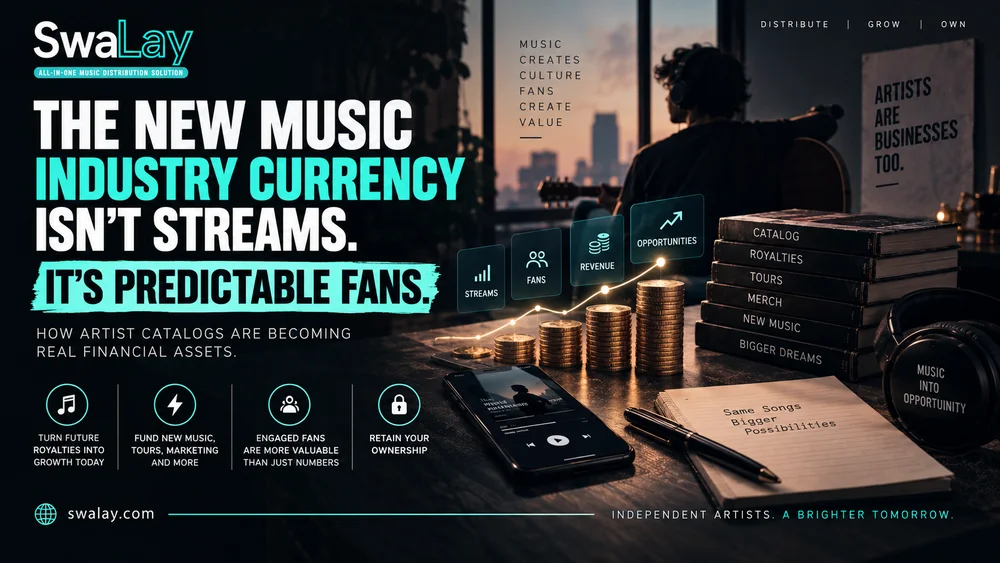
That changes the traditional equation.
Instead of an artist waiting months for royalties to arrive, future earnings can potentially become working capital today. CreatorFi says artists can use advances for studio costs, tours, marketing, new releases, team building and audience growth while retaining ownership of their music. Repayment is tied to incoming revenue rather than a conventional fixed payment structure.
Your Back Catalog Could Become Your Bank
This is where the story gets particularly interesting for independent artists.
A successful song is no longer just intellectual property sitting inside a distributor dashboard. If it generates consistent royalties, it can become evidence of predictable future income.
And the market is becoming large enough for financial companies to take that seriously.
Spotify says it paid more than $11 billion to the music industry in 2025, while independent artists and labels accounted for half of its royalties. Spotify also says there are now more artists generating more than $100,000 annually from the platform than there were artists stocked on record-store shelves during the peak CD era.
That creates something the old music industry rarely had at scale:
a measurable, recurring income history for independent artists.
The Most Important Metric May Be Fandom
There is another layer to this shift.
Investors are beginning to look beyond follower counts.
CreatorFi says its underwriting considers audience engagement and the strength of an artist or creator’s intellectual property, not simply how large their following is. Its recent financing activity reflects a broader belief that creators with deeply engaged audiences can represent durable businesses.
That is a major change in thinking.
A creator with 500,000 passive followers may be less commercially interesting than an artist with 50,000 people who repeatedly stream their songs, attend shows, buy merchandise and support new releases.
Reach gets attention.
Fandom creates economic value.
That idea is already becoming visible elsewhere in the industry. At Spotify's recent India Loud & Clear event, Spotify executives described discovery as the beginning of a chain that moves from audiences to fans and ultimately to economic value.
What This Means for Independent Artists
The next generation of independent musicians may have more options than simply choosing between self-funding and signing away rights.
A healthy catalog could potentially support:
New music production
Marketing campaigns
Touring
Collaborations
Team expansion
Better distribution
Audience development
The bigger opportunity is not simply getting money earlier.
It is being able to reinvest proven music income into creating the next source of income.
That could turn the independent artist from a creator waiting for royalties into something closer to a small media company managing an income-generating intellectual property portfolio.
And that is the part of the music business worth watching.
Because the next revolution in independent music may not come from another streaming platform.
It may come from Wall Street finally understanding what a loyal fanbase is worth.
For companies like SwaLay, operating in an ecosystem where independent artists increasingly control their distribution, rights and catalog data, this shift is especially significant. The more transparent an artist's digital income becomes, the more possibilities emerge around how that music business can grow.
The future of music may not belong only to artists with the biggest hits.
It may belong to artists whose audiences are valuable enough to finance what comes next.