
It is one of the most frequent and emotionally charged questions we get at SwaLay Digital: "I recorded a beautiful bhajan. I spent money on production. I uploaded it through your platform. Why will you not activate Content ID for it?"
We understand the frustration. You created something with devotion and effort. You want it protected. But the reason your bhajan or devotional track does not qualify for YouTube Content ID or Meta Rights Manager is not that your distributor is lazy or incompetent. It is because YouTube and Meta themselves explicitly prohibit it. And this applies to every single distributor on the planet, not just yours.
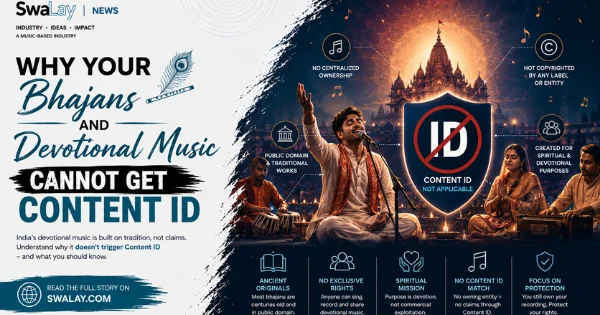
Let us explain why, and more importantly, what you can actually do about it.
What YouTube and Meta actually say
YouTube's official Content ID eligibility guidelines list specific categories of content that cannot be registered in the system. Among these explicitly excluded categories are "public domain footage, recordings, or compositions." This is not buried in fine print. It is a core eligibility requirement that every Content ID partner must follow.
Meta's Rights Manager follows an identical policy. Content that consists of "public domain content including hymns, classical compositions, nursery rhymes, and holiday songs" or "ambient or meditation audio including nature sounds, binaural beats, and sleep music" is ineligible for monetisation through Rights Manager.
These are not Indian-specific rules. They are global policies that apply to every artist and distributor worldwide. SwaLay, TuneCore, DistroKid, Ditto Music, LANDR, CD Baby, SoundCloud, and every other distributor you have heard of follow exactly the same restrictions.
Why these rules exist
The reasoning behind these policies is straightforward. Content ID and Rights Manager work by matching uploaded content against a database of registered works. When a match is found, the rights holder can claim the content. But if a traditional bhajan like Hanuman Chalisa or Gayatri Mantra is registered in Content ID, every other person who uploads their own version of the same bhajan would receive a false copyright claim.
Hanuman Chalisa was composed by Tulsidas in the 16th century. It belongs to everyone. No single person or company can claim exclusive rights over the text or the traditional melody. If YouTube allowed Content ID claims on Hanuman Chalisa, millions of devotional videos uploaded by temples, priests, and devotees around the world would receive copyright strikes for singing a prayer that has been in the public domain for over 400 years.
The same logic applies to Gayatri Mantra, Om Jai Jagdish Hare, Ram Bhajan, Shiv Chalisa, and thousands of other traditional devotional compositions. These belong to the cultural and spiritual commons of humanity. No platform will allow a single party to monopolise them.
But wait, T-Series has Content ID on their bhajans
This is the argument we hear most often, and it deserves a detailed response. Yes, T-Series has Content ID protection on their bhajan recordings. But they are not claiming copyright on Hanuman Chalisa itself. They are claiming copyright on their specific sound recording of Hanuman Chalisa.
There is a crucial legal distinction between the composition (the melody and lyrics, which may be public domain) and the sound recording (the specific recording of that composition, which is an original copyrighted work).
When T-Series records a bhajan, they hire professional singers, musicians, and producers. They create an original arrangement with unique instrumentation, vocal performance, and production quality. That specific audio recording is a new copyrighted work owned by T-Series, even though the underlying bhajan is centuries old.
Content ID protects T-Series' specific recording. If someone uploads a YouTube video using T-Series' actual audio file, Content ID catches it. But if someone else records their own version of the same bhajan with their own voice and instruments, T-Series' Content ID will not claim it because it is a different sound recording.
When does a bhajan recording qualify for Content ID?
Your bhajan recording can potentially qualify for Content ID if it meets ALL of these conditions: the arrangement is substantially original with unique instrumentation, harmonies, or structural changes that distinguish it from traditional versions; the vocal performance is original and professionally recorded; the production (mixing, mastering, sound design) is distinctive; and most importantly, the audio fingerprint is sufficiently different from other versions already in the Content ID system.
Even with all of these conditions met, platforms may still reject bhajan recordings because the category is inherently high-risk for false claims. A platform that allows bhajan Content ID claims has to deal with thousands of dispute cases when legitimate uploaders receive false strikes on their own original recordings of the same traditional composition.
What Ditto Music, TuneCore, and others say
To be absolutely clear that this is not a SwaLay-specific policy, here is what other major distributors say on the exact same topic.
Ditto Music's Content ID FAQ explicitly states that "Public Domain content, including but not limited to Religious Songs or Hymns, Classical Music, Children's Nursery Rhymes or Songs, Holiday Songs" is ineligible for Content ID.
TuneCore's Meta monetisation policy similarly excludes "covers of traditional or public domain songs (including but not limited to: children's music, classical pieces, holiday songs, or religious songs/hymns)" from eligibility.
Every legitimate music distributor follows these same rules because they are enforced at the platform level. A distributor that registers ineligible content for Content ID risks penalties for their entire catalogue, affecting thousands of other artists. No responsible distributor will take that risk.
So what CAN you do to protect your devotional music?
Not qualifying for Content ID does not mean your bhajan recording has zero protection. Several alternative protection methods are available, and they are worth using.
Formal copyright registration with the Copyright Office of India protects your specific sound recording regardless of whether the underlying composition is in the public domain. Register at copyright.gov.in for ₹2,000 per sound recording. Your registration certificate proves you own that particular recording, even if the bhajan itself is traditional.
Lyrics DNA certification through the ICA Foundation provides blockchain-anchored, timestamped proof that you created your specific version on a specific date. This is particularly useful in disputes where someone claims your arrangement or production as their own.
Audio fingerprinting through services like ACRCloud and AudD can monitor the internet for unauthorised copies of your specific recording. Even without Content ID, you can detect when someone uses your actual audio file on YouTube or elsewhere.
Manual DMCA takedown requests can be filed directly through YouTube and Meta if you find someone using your specific recording without permission. This is more labour-intensive than automated Content ID, but it is effective for specific instances of infringement.
A word about honesty
We know this is not the answer most devotional music artists want to hear. You want the blue checkmark of Content ID protection on your bhajan. You want the passive income of automated monetisation whenever someone uses your track. We understand.
But the honest truth is that platform policies exist for good reasons, and no distributor can change them. Any distributor who promises you Content ID on traditional devotional music is either lying to you or does not understand the rules. When those claims inevitably get rejected or removed, it is the artist who suffers.
At SwaLay Digital, we would rather tell you the truth up front and help you find alternative protections than make promises we cannot keep. That is what a responsible distributor does.
If you have a devotional track with genuinely original composition, not just a new recording of a traditional melody but a new song with new lyrics and a new tune inspired by devotional themes, that absolutely qualifies for Content ID. We are happy to register it. The distinction is between traditional compositions (public domain, ineligible) and new original compositions in the devotional genre (copyrightable, eligible).
Create original devotional music. The audience is massive, the streaming numbers are strong, and the protection is available. Just make sure it is truly original.
SwaLay Digital is a provider member of the Indian Music Industry (IMI), affiliated with IFPI. ISO/IEC 27001:2022 Certified.