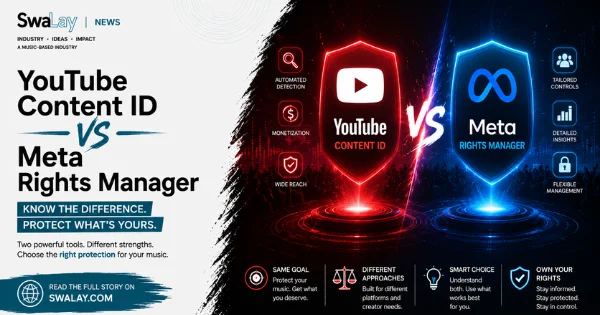
Every week, we receive messages from artists asking the same question: "Why is my Content ID not working?" or "Why was my music removed from Instagram?" The confusion is understandable. YouTube Content ID and Meta Rights Manager are two of the most powerful tools available for protecting and monetising your music online, but they work very differently, and not every piece of music qualifies for either.
If you are an independent artist or label in India distributing music through any platform, understanding the difference between these two systems could mean the difference between earning royalties on unauthorised uses of your music and watching others profit from your work with no recourse.
What is YouTube Content ID?
YouTube Content ID is an automated digital fingerprinting system that scans every video uploaded to YouTube against a database of registered audio and video files. When someone uploads a video that contains your music, whether it is a full upload, a background track in a vlog, or a snippet in a meme, Content ID detects the match and gives you three options: block the video entirely, track its performance data, or monetise it by placing ads on the video and collecting the revenue.
The system is remarkably effective. YouTube processes over 500 hours of video uploads every minute, and Content ID scans all of it in real time. For artists whose music frequently gets used in user-generated content, this can become a significant and entirely passive revenue stream.
But Content ID is not available to everyone. YouTube restricts access to rights holders who own a substantial catalogue of original content and can demonstrate that they have the rights to the material. In practice, this means you need to go through an authorised Content ID partner, which is typically your music distributor.
What is Meta Rights Manager?
Meta Rights Manager is the equivalent system for Facebook and Instagram. It works on a similar principle: you register your audio content, and Meta's system scans all videos, Reels, and Stories uploaded across Facebook and Instagram for matches. When a match is found, you can choose to block the content, monitor it, or claim ownership.
Rights Manager is particularly important in India because of the explosive growth of Instagram Reels. When someone uses your song in a Reel, and it goes viral, Rights Manager ensures you get credit and potential monetisation rather than watching your music spread with no attribution or compensation.
Like Content ID, Rights Manager has eligibility requirements. Not all content qualifies, and the system is typically accessed through your music distributor, who delivers your catalogue to Meta's music library.
What content does NOT qualify?
This is where most of the confusion and frustration come from. Both YouTube and Meta have strict policies about what content is eligible for Content ID and Rights Manager protection. The following categories are explicitly ineligible on both platforms.
Public domain compositions are the biggest exclusion. Traditional bhajans, hymns, classical ragas, nursery rhymes, holiday songs, and folk melodies that have been in the public domain for decades cannot be registered for Content ID or Rights Manager monetisation. This is a global policy that applies equally to every distributor worldwide, from TuneCore and DistroKid to Ditto Music and SwaLay Digital.
Ambient and meditation audio is also excluded. Nature sounds, binaural beats, white noise, rain sounds, and generic meditation music do not qualify. If your track consists primarily of non-musical ambient audio, it will be rejected or removed.
Non-exclusive content creates problems too. If you have distributed the same track through multiple distributors, or if the track contains samples or elements that others also have rights to, Content ID and Rights Manager will flag conflicts rather than granting you exclusive protection.
Sound effects, karaoke tracks, and generic production music are also typically excluded from these systems.
The T-Series question: if bhajans are in the public domain, why does T-Series have Content ID on theirs?
This question comes up constantly, and it deserves a clear answer. When T-Series releases a bhajan, they are not claiming copyright on the ancient religious text or traditional melody. They are claiming copyright on their specific sound recording: the particular arrangement, the studio production, the singer's performance, the mixing and mastering. That specific recording is an original copyrighted work, even though the underlying composition may be centuries old.
The distinction is between the composition (the melody and lyrics, which may be public domain) and the sound recording (the specific recording of that composition, which is copyrighted). T-Series owns the sound recording rights to their version. You can sing the same bhajan and record your own version, but you cannot use their recording.
If you create a genuinely original arrangement of a traditional bhajan with original music production, unique vocal performance, and distinctive arrangement, your sound recording may qualify for Content ID. But if your version is a straightforward rendition of a traditional melody with standard production, platforms are likely to classify it as public domain content and reject it.
How Content ID and Rights Manager actually generate money
When your music is registered in Content ID, and someone uses it in their YouTube video, the system identifies the match, and you get to choose what happens. If you choose to monetise, YouTube places ads on that video and shares the ad revenue with you. The split is typically 55% to the rights holder and 45% to YouTube.
On Meta, the monetisation model is evolving. Currently, Rights Manager primarily serves as a detection and enforcement tool rather than a direct monetisation platform. When your music is used in a Reel or Story, you can track the usage, block it, or allow it. Meta does share some ad revenue with rights holders through its music licensing agreements, but the per-use payments are generally lower than those of YouTube.
For most Indian independent artists, the real value of these systems is not direct monetisation but protection. Knowing when and where your music is being used, having the ability to take down unauthorised copies, and preventing others from claiming ownership of your work are the primary benefits.
What your distributor should be doing for you
Your music distributor plays a critical role in Content ID and Rights Manager protection. When your distributor delivers your music to YouTube and Meta, they should simultaneously be registering your eligible tracks in Content ID and Rights Manager.
If you are unsure whether your tracks are registered, ask your distributor directly. Request a platform-wise breakdown of your catalogue coverage. Your distributor should be able to tell you exactly how many of your tracks are registered in Content ID, how many are in Meta Rights Manager, and how many were rejected and why.
At SwaLay Digital, we deliver music to both YouTube Music and Meta and simultaneously register eligible content for Content ID and Rights Manager through our aggregator partners. When content is flagged as ineligible, we communicate the specific reason to the artist so there is no confusion about why protection was not activated.
What to do if your content was rejected
If your music was rejected for Content ID or Rights Manager, do not panic. First, understand the reason. If it was flagged as public domain, review your content honestly: is the underlying composition truly original, or is it based on a traditional melody?
If you believe your content was incorrectly classified, gather evidence of originality. This could include original composition notes, studio session recordings, producer agreements, or any documentation that proves the melody, lyrics, and arrangement are your original creation. Submit this evidence to your distributor and ask them to appeal the classification.
If the content genuinely falls into an ineligible category, accept the limitation. Content ID and Rights Manager are not the only ways to protect your music. Copyright registration, audio fingerprinting, and Lyrics DNA certification provide alternative protection that does not depend on platform-specific eligibility rules.
The bottom line
YouTube Content ID and Meta Rights Manager are powerful tools, but they are not universal protections. Understanding their limitations, especially around public domain content, is essential for every independent artist. Do not blame your distributor when platform policies exclude certain categories of music. Instead, focus on creating original content that qualifies for the fullest possible protection, and use complementary tools like copyright registration and audio fingerprinting to fill any gaps.
The artists who succeed in 2026 are not the ones who complain about platform rules. They are the ones who understand the rules and build their strategy around them.
SwaLay Digital is a provider member of the Indian Music Industry (IMI), affiliated with IFPI. ISO/IEC 27001:2022 Certified.